
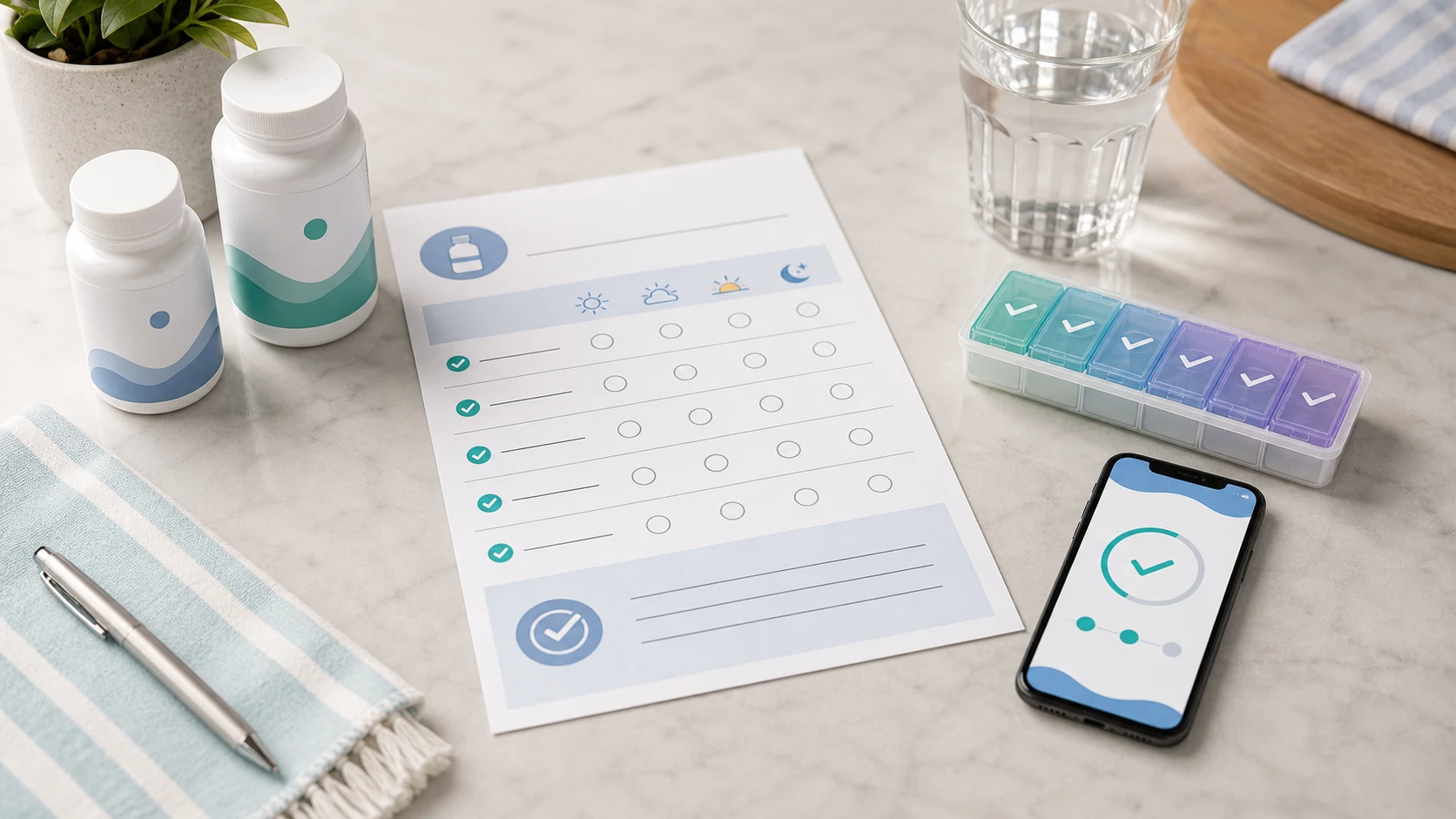
A vitamin schedule template helps you turn a pile of bottles into a simple daily plan. Instead of guessing what to take, when to take it, or whether you already took it, a schedule gives each supplement a clear place in your day. The goal is not to create a complicated health spreadsheet. The goal is to make your routine easier to remember, easier to follow, and easier to repeat. A good vitamin schedule shows what you take, when you take it, whether it should be taken with food, and when you need to restock.
What Is a Vitamin Schedule Template?
A vitamin schedule template is a simple planner for organizing your supplements by time, serving size, and routine. If you have not chosen the routine itself yet, start with how to build a simple vitamin routine.
Why a Vitamin Schedule Helps
A schedule removes the daily confusion around supplements.
Most people do not forget vitamins because they are careless. They forget because the routine is unclear. One bottle says take with food. Another sits near the bed. Another is still in the cabinet. A few days later, it becomes hard to remember what happened.
A vitamin schedule solves this by putting everything in one place:
- What you take
- How much you take
- When you take it
- Whether you take it with food
- Whether you took it today
- When the bottle is running low
That may sound basic, but basic is the point. If the plan is easy to understand, it is easier to follow.
A vitamin schedule gives your supplement routine a clear structure instead of relying on memory.
Who Should Use a Vitamin Schedule?
A vitamin schedule can help anyone who takes more than one supplement or struggles with consistency.
It is especially useful if:
You forget your vitamins several times per week.
You take different supplements at different times.
You are not sure whether you already took them today.
You keep running out without noticing.
You want to build a simple morning or night routine.
You want to track your habit over time.
You do not need a complicated routine to benefit from a schedule. Even one daily multivitamin can be easier to remember when it has a specific time, place, and reminder.
If you have ever asked, "Did I take my vitamins today?" a schedule can help.
A vitamin schedule template is useful because it turns intention into a repeatable system.
The Simple Vitamin Schedule Template
Start with a template that is clear enough to use every day.
Daily Vitamin Schedule Template
Use this basic template to organize your daily supplements.
This table works because it keeps the routine simple. You are not trying to remember everything from scattered bottles. You are building one master schedule.
Here is how to fill it out:
Time of Day: Choose morning, midday, evening, or bedtime.
Supplement: Write the product name.
Serving Size: Write the suggested serving from the label.
With Food?: Note whether you plan to take it with a meal.
Reminder Time: Choose a real time you can act on.
Taken Today?: Check it off after taking it.
Notes: Add anything important from the label or your routine.
The best vitamin schedule is simple enough that you actually use it.
If you want a ready starting point, pair this template with the morning vitamins checklist or the night vitamin routine checklist.
Example Vitamin Schedule
Here is a sample version of what a completed schedule might look like.
This is only an example. Your schedule should match your actual products, your label directions, and your daily habits. The main lesson is that each supplement has a place. Nothing is floating around in your memory.
A sample schedule helps you see how simple the system can be.
Weekly Vitamin Refill Template
A daily schedule helps you take your vitamins. A weekly refill template helps you avoid running out.
Use this simple refill tracker:
This is useful because running out breaks the routine. If your reminder goes off but the bottle is empty, the habit stops. A refill tracker helps you reorder before that happens.
A simple rule is to check supply once per week. Choose one day, such as Sunday evening, and make it part of your reset routine.
A refill tracker protects your vitamin habit before the bottle is empty.
A good schedule includes both daily doses and weekly supply checks.
How to Build Your Personal Vitamin Schedule
Your schedule should match your real life, not an ideal version of your life.
Step 1: List Every Vitamin and Supplement
Start by gathering every supplement you currently take.
Write down the product name, serving size, and label directions. This includes vitamins, minerals, gummies, capsules, powders, herbs, probiotics, and any other dietary supplements in your routine.
A clear list prevents overlap and confusion. It also helps you notice products you are not actually taking. If something is not part of your daily routine, do not force it into the daily schedule. Put it in an occasional use section or remove it from the routine area.
Your schedule should begin with a complete and honest list.
Step 2: Read the Suggested Use Directions
Before assigning a time, read the label.
Look for:
- Serving size
- Suggested use
- Food instructions
- Warning statements
- Storage instructions
- Servings per container
The label gives your schedule its starting point. If a product says to take one serving daily, write that down. If it suggests taking with food, place it near a meal. If it has storage instructions, do not leave it somewhere that conflicts with those directions.
Label directions should guide the schedule before convenience does.
Step 3: Group Supplements by Time of Day
Now decide whether each supplement belongs in the morning, midday, evening, or bedtime section.
Do not create more time blocks than you need. Most people should start with one or two routine times. A four part schedule may look organized, but it can be harder to follow.
Common schedule styles:
Morning only: Best for a simple daily routine.
Morning and night: Best for people with a clear evening habit.
Meal based: Best for people who take supplements with food.
Weekly support: Best for refilling organizers and checking supply.
A simple schedule is usually more effective than a complicated one.
If you are deciding between routine blocks, the guide to morning vs night vitamin routines explains how to choose a time you can repeat.
Step 4: Add Reminder Times
Every supplement time block should have a reminder.
The reminder should happen when you can actually respond to it. If you are always driving at 8:00 AM, do not set the reminder for 8:00 AM. If breakfast is at 9:30 AM, use 9:30 AM. If your evening routine starts after brushing your teeth, set the reminder around that habit.
Good reminder examples:
- "Take morning vitamins with breakfast."
- "Take supplements after coffee."
- "Take evening vitamins after brushing teeth."
- "Check Vitamin Alerts and mark complete."
- "Refill vitamin organizer."
A reminder should tell you exactly what to do at the exact time you can do it.
Step 5: Track Completion Immediately
A schedule only works if you mark it after taking your vitamins.
Do not wait until later. Later is when you forget. The best sequence is simple:
- Reminder goes off.
- Take vitamins.
- Mark complete.
- Move on.
You can track with a printable schedule, a notes app, a calendar, a pill organizer, or Vitamin Alerts. The tool matters less than the habit of checking it off right away.
Tracking completion is what turns your schedule into a reliable record.
Build your vitamin schedule around your actual products, actual day, and actual ability to follow through.
Morning, Midday, and Evening Vitamin Schedule Ideas
Different people need different schedule styles.
Morning Vitamin Schedule
A morning schedule works well when you already have a breakfast, coffee, or water routine.
Example:
Morning works because it happens early. If you take your supplements in the morning, you do not have to keep remembering them all day. The downside is that rushed mornings can make the habit easier to skip.
A morning vitamin schedule works best when your mornings are predictable.
Midday Vitamin Schedule
A midday schedule can work if lunch is your most consistent meal.
This may be useful for people who skip breakfast, work from home, or have a reliable lunch break. The challenge is that midday routines are often more interrupted than morning or night routines. If you choose midday, make the reminder specific and keep your supplements accessible.
Example reminder:
- "Take lunch vitamins with water before returning to work."
A midday schedule works best when lunch is consistent and your supplements are easy to access.
Evening Vitamin Schedule
An evening schedule works well when your nights are calmer than your mornings.
You can connect the routine to dinner, brushing your teeth, filling a bedside water glass, or preparing for bed. Evening routines are helpful because they often happen in the same place. The risk is waiting too late and becoming too tired to care.
Example:
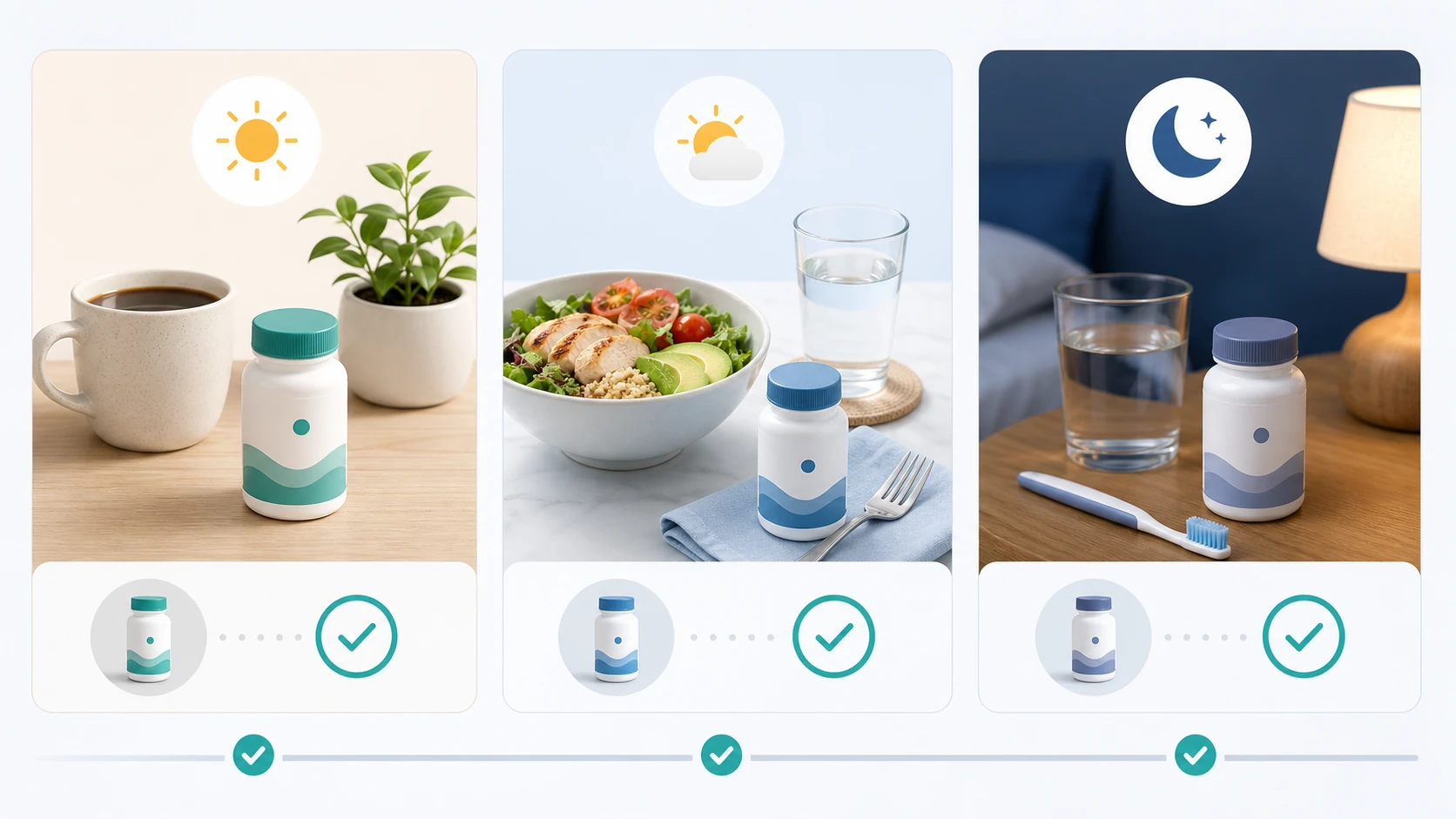
An evening vitamin schedule works best when it is tied to a calm routine you already follow.
Choose the schedule style that fits your most reliable part of the day.
How to Use Vitamin Alerts With Your Schedule
A template gives you the plan, and Vitamin Alerts helps you follow it.
Turn Each Time Block Into a Reminder
Once your template is filled out, convert each time block into a reminder.
If your schedule says morning vitamins at 8:00 AM, create an 8:00 AM reminder. If your schedule says magnesium at 9:00 PM, create a 9:00 PM reminder. If Sunday is your refill day, create a weekly refill reminder.
This turns your static schedule into an active system. Instead of hoping you remember, your phone prompts you at the right time.
Every time block in your schedule should become a real reminder.
For a step-by-step phone setup, read how to set supplement reminders on your phone.
Mark Each Dose Complete
The most important feature of any vitamin schedule is knowing whether you took the dose.
When you take your vitamins, mark them complete. This solves the common problem of looking at a bottle and wondering, "Did I already take that?" A checkmark gives you certainty.
Vitamin Alerts is designed around this exact problem: helping people remember the vitamins they already bought and take them consistently.
The checkmark matters because it replaces uncertainty with proof.
Add a Weekly Supply Check
A good vitamin schedule should include supply tracking.
If you know a bottle has 60 servings and you take one serving per day, you can estimate when it will run low. Add a weekly supply check so you have time to reorder before the bottle is empty.
This matters because consistency is not only about remembering. It is also about having the product available when the routine happens.
Weekly supply checks help prevent the routine from stopping because the bottle ran out.
Vitamin Alerts can turn your schedule from a written plan into a daily reminder routine. Pair it with a weekly supply check until automatic supply tools are added.
Conclusion: A Vitamin Schedule Template Makes Consistency Easier
A vitamin schedule template helps you stop guessing and start following a clear routine. List your supplements, read the label directions, group them by time of day, add realistic reminders, track completion, and check your supply once per week. The schedule does not need to be perfect. It needs to be simple enough to use. When your vitamins have a clear time, place, reminder, and checkoff, consistency becomes much easier.
FAQ
What is a vitamin schedule template?
A vitamin schedule template is a planner that helps you organize your vitamins and supplements by time of day, serving size, food instructions, reminder time, and completion tracking.
How do I make a daily vitamin schedule?
To make a daily vitamin schedule, list your supplements, read each label, decide when each one fits into your day, set reminders, and mark each dose complete after taking it.
Should my vitamin schedule be morning or night?
Your vitamin schedule should match your real routine and the product label directions. Morning is often easier for people with a steady breakfast routine, while night may work better for people with calm evenings.
How do I track my vitamins every day?
You can track your vitamins with a printable template, pill organizer, calendar, notes app, or vitamin reminder app. The most important step is marking each dose complete immediately after taking it.
What should I include in a supplement schedule template?
A supplement schedule template should include time of day, supplement name, serving size, whether it is taken with food, reminder time, completion checkbox, notes, and refill date.
How can Vitamin Alerts help with my vitamin schedule?
Vitamin Alerts can help you turn your schedule into daily reminders and a clearer daily routine. For supply, use a weekly bottle check so you know when products are getting low.
Turn this guide into a real reminder routine.
Vitamin Alerts helps you add vitamins, choose routine times, test alerts, and come back to the same schedule tomorrow.
Comments
Public comments are coming later. For now, send article feedback or vitamin routine questions through the support page.
Contact support